
Holtrow · User Guides
How to use
your Holtrow
Pick your device below — every step from unboxing to your daily routine, for the Pulse neckband, the Drift sleep device and the Flow recovery boots.
Holtrow Pulse · User Guide
The 4-minute reset, step by step
Everything you need — from your first charge to your nightly routine.
Before you begin
What's in the box
First-time setup: Charge the device fully before first use. The included remote controls all four modes and intensity out of the box — nothing to pair, nothing to install.
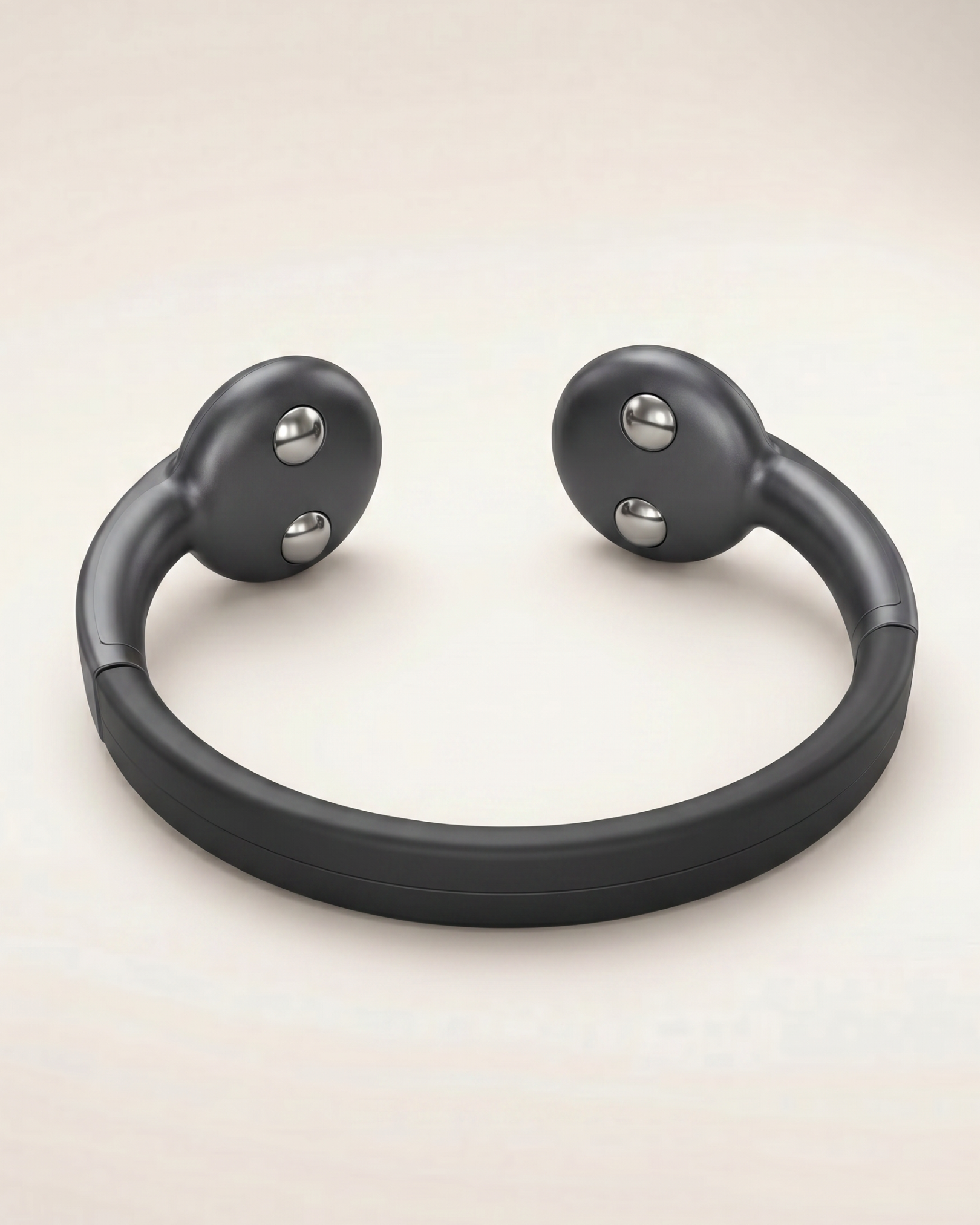
See it work
Gentle pulses, right where the nerve runs
The electrodes rest on the left side of your neck, where the vagus nerve passes closest to the skin. Soft micro-pulses travel along it, telling your nervous system it's safe to downshift.
The signal
- Light, rhythmic tingling — never sharp
- About 4 minutes per session · auto shut-off
- Gentle 5–30 Hz pulses — the vagus nerve's range
Micro-pulses travel up the vagus nerve — the body's built-in calm switch.
The 4-minute reset
Step by step
The whole routine takes about four minutes. Do it seated or lying down, somewhere you can relax.
Apply a little gel
Place a small drop of the conductive gel on each metal electrode (or directly on the left side of your neck). The gel helps the gentle pulse travel comfortably into the skin.
Place it on your neck
Rest the band around the base of your neck so the electrodes sit on the left side, just below the jaw where the vagus nerve runs closest to the surface. It should feel snug but never tight.
Choose your mode & start
Press the power button once to turn on, then select a mode — Relax, Sleep, Focus or Recovery — with the button on the band or the included remote. Press start. You'll feel a light, rhythmic tingling: that's the stimulation working.
Relax for ~4 minutes
Breathe slowly and let the session run. Read, scroll, meditate or simply close your eyes. The device powers down automatically at the end of the cycle. Switch sides for a second cycle if you like.
Four guided modes
Pick the mode for the moment
Relax
A balanced, everyday calm session to take the edge off stress and reset a busy mind.
Sleep
A slower, lower-frequency wind-down that signals the body it's safe to switch off.
Focus
Quiets mental noise to help you settle into steady, sustained concentration.
Recovery
Supports the rest-and-repair state your body uses to bounce back after hard days.
How often
Build it into your day
Once or twice daily is ideal — 4 minutes per session. Consistency matters far more than long sessions.
- Use Relax or Focus for 4 minutes with your coffee
- Sets a calm, clear baseline before the day's demands
- Great alternative to a second cup of caffeine
- Use Sleep mode ~30 minutes before bed
- Pair with dim lights and slow breathing
- Helps quiet a racing mind and ease into sleep
Many people feel a wave of calm in their very first session. Deeper benefits to sleep and baseline stress build over 2–4 weeks of daily use — think of it like training a muscle.
Care & charging
Keep it in top shape
- Wipe the electrodes with a soft, slightly damp cloth after each use to remove gel residue.
- Never submerge the device in water; keep the charging port dry.
- Recharge via USB-C when the indicator is low — a full charge takes about 2 hours.
- Store in a cool, dry place; replace the conductive gel when it runs low for the best contact.
- A 12 hr+ battery means most people only charge once a week.
Safety first
Important precautions
Holtrow Pulse is a non-invasive wellness device, not a medical treatment, and is not intended to diagnose, treat or cure any condition. The pulse should always feel gentle — if it's ever uncomfortable, lower the intensity or stop.
Do not use if you:
- Are pregnant
- Have a pacemaker or any implanted electronic/metallic device
- Have epilepsy or a seizure disorder
- Have a heart condition or arrhythmia
- Have carotid artery disease or have had a stroke
Avoid placing the electrodes over broken skin. If you have a medical condition or any doubt, consult your doctor before use.
Troubleshooting
Quick fixes
I can't feel anything
Add a little more conductive gel, make sure the electrodes sit flush against the left side of your neck, and slowly raise the intensity. Dry skin or lotion is the most common cause of weak contact.
It feels too strong or sharp
Lower the intensity immediately. The sensation should be a gentle, steady tingle — never a sting. Re-positioning the band slightly often makes it more comfortable.
It won't turn on
Charge it for at least 30 minutes with the included USB-C cable. A solid indicator light means it's charging; if it still won't power on, try a different USB adapter.
How long until I see results?
A calming effect is often felt in the first session. Sleep and baseline-stress improvements typically build over 2–4 weeks of daily, consistent use.
Ready for your first reset?
Shop Holtrow PulseHoltrow Drift · User Guide
Twenty minutes to switched off
Clip it to your ears, hold it in your palm, or both — from first charge to falling asleep mid-session.
Before you begin
What's in the box
First-time setup: Charge fully before first use, then start on level 1 — the sensation is deliberately barely-there. The display shows your program (M1–M3), the intensity bars, and which contact points are live.
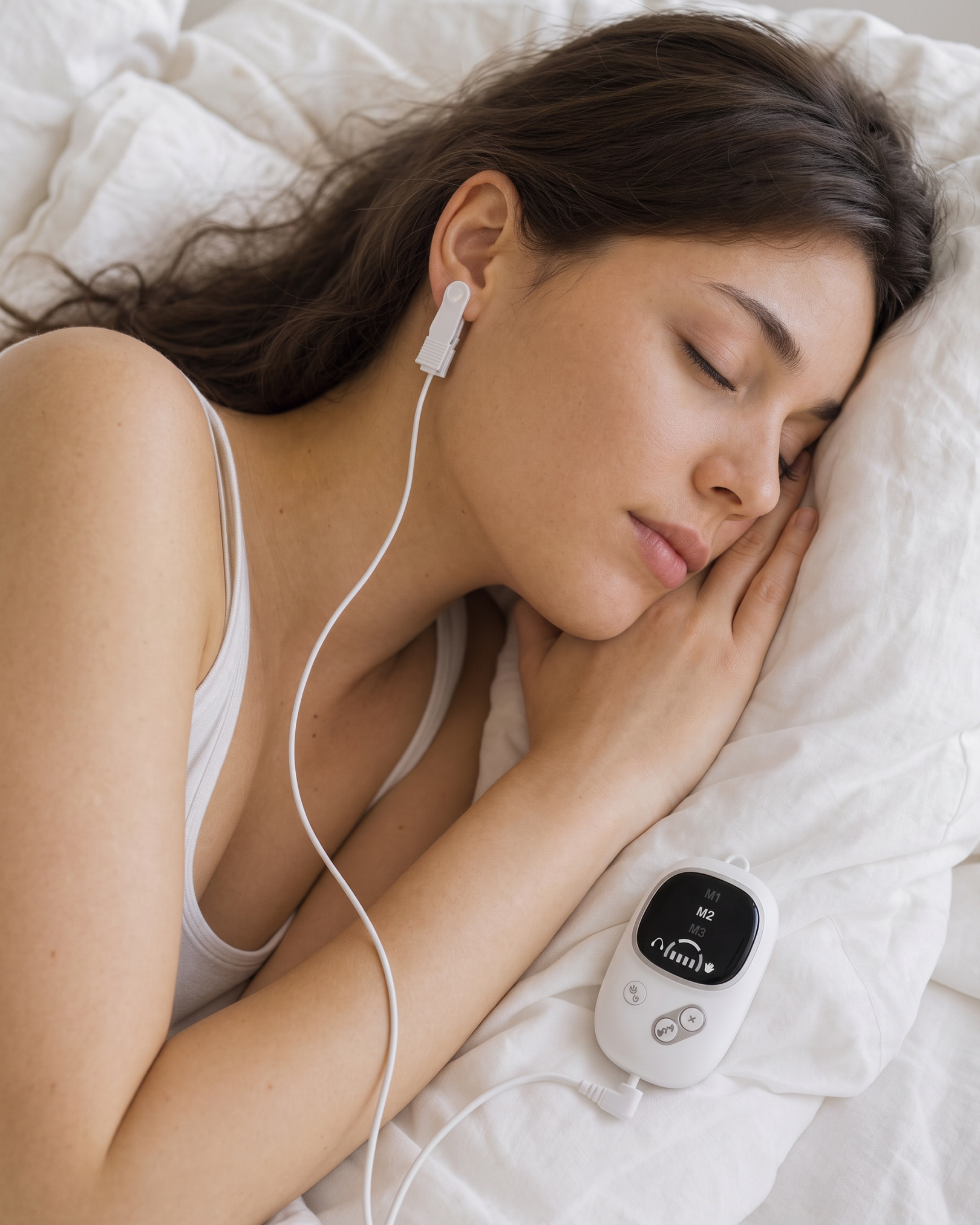
See it work
A whisper of current, wherever you hold it
Drift sends a gentle microcurrent through the earlobes or the palm — nudging a racing mind toward slower, sleep-ready rhythms. Same signal either way; pick the contact that feels natural.
Where the signal goes
Both contact points reach the same quiet place.
- Microcurrent nudges the brain toward slower, sleep-ready rhythms
- 20-minute session with auto shut-off — fall asleep wearing it
- Drug-free and non-habit-forming — nothing to take, nothing to wear off
The sensation is a faint, pleasant tingle at the earlobe — or a soft pulse in the palm. You set the level, from barely-there to noticeable.
The 20-minute wind-down
Step by step
Do it in bed with the lights low — the session ends itself, so there's nothing to remember.
Charge & power on
Top up with the Type-C cable — about 3 hours to full, good for 8–10 hours of use. Long-press the power button until the display lights up.
Clip on, hold — or both
Plug in the cable and rest a soft clip on each earlobe, or skip the cable and hold the device so the steel rings sit against your palm (the strap keeps it there as you doze). Both at once is fine too.
Pick a program & level
Short-press to cycle through the programs — M1 Relax, M2 Sleep, M3 Lift — then use +/− to set one of three intensity levels. You'll feel a faint, pleasant tingle at the earlobes or a soft pulse in the palm.
Drift off
Let the session run — 20 minutes, then it switches itself off. You can fall asleep wearing it; there's nothing to turn off and nothing to wake you.
Three programs
Pick the program for the moment
Relax
Softens the edge of a wired evening — the everyday unwind for a busy mind.
Sleep
The slowest rhythm — nudges a racing mind toward sleep-ready calm.
Lift
A brighter gear for heavy mornings and low-energy afternoons.
Every program runs at three intensity levels — start low and let it stay subtle.
How often
Build it into your night
One 20-minute session a night is the core habit — daytime sessions are a bonus, not a requirement.
- M2 Sleep at level 1–2, clipped on or in your palm
- Start it as you settle in — it shuts off by itself
- Most people are asleep before the session ends
- M1 Relax after dinner, screens down
- Twenty minutes on the couch, book or podcast on
- Takes the static out of the evening before bed
- M3 Lift with your coffee on heavy days
- A gentle nudge instead of a second cup
- Also good for the mid-afternoon dip
Many people notice an easier drift-off within the first nights. Steadier, deeper sleep builds over 2–4 weeks of nightly use — consistency beats intensity.
Care & charging
Keep it in top shape
- Wipe the ear clips and the steel contact rings with a soft, dry cloth after use.
- Never submerge the device; keep the Type-C port dry.
- Recharge when the battery indicator runs low — about 3 hours to full, 8–10 hours of use per charge.
- Coil the ear-clip cable loosely and store everything in a cool, dry place.
- At 20 minutes a night, most people charge every few weeks.
Safety first
Important precautions
Holtrow Drift is a non-invasive wellness device, not a medical treatment, and is not intended to diagnose, treat or cure any condition. The current should always be faint and pleasant — if it's ever uncomfortable, lower the level or stop.
Do not use if you:
- Are pregnant
- Have a pacemaker or any implanted electronic/metallic device
- Have epilepsy or a seizure disorder
- Have a heart condition or arrhythmia
Avoid placing the clips or rings on broken skin. If you have a medical condition or any doubt, consult your doctor before use.
Troubleshooting
Quick fixes
Ear, hand, or both — which should I use?
The signal reaches the same quiet place either way, so it's purely a comfort choice. Side sleepers tend to prefer the palm; both at once is fine for the fullest session.
I can't feel anything
That can be normal on level 1 — it's deliberately barely-there. Check the clips sit on the earlobes (not the cartilage) or the steel rings rest against bare palm skin, then raise the level one step at a time.
It feels too strong or prickly
Lower the level straight away — the sensation should be a faint, pleasant tingle, never sharp. Re-seating the clips slightly lower on the lobe usually softens it too.
It won't turn on
Charge it for at least 30 minutes with the Type-C cable, then long-press the power button. If it still won't wake, try a different USB adapter.
Can I fall asleep wearing it?
Yes — that's the design. The session switches itself off after 20 minutes, so there's nothing to remember and nothing to wake you.
How long until I see results?
Many people notice an easier drift-off within the first few nights. Steadier sleep quality typically builds over 2–4 weeks of consistent nightly use.
Ready to switch your mind off?
Shop Holtrow DriftHoltrow Flow · User Guide
15 minutes to lighter legs
How to zip in, dial your pressure and let the sequential wave do the work — from first charge to your post-run ritual.
Before you begin
What's in the box
First-time setup: Charge fully before your first session, then run your first cycle at a low pressure (around 80–120 mmHg) to learn how the wave feels before turning it up.
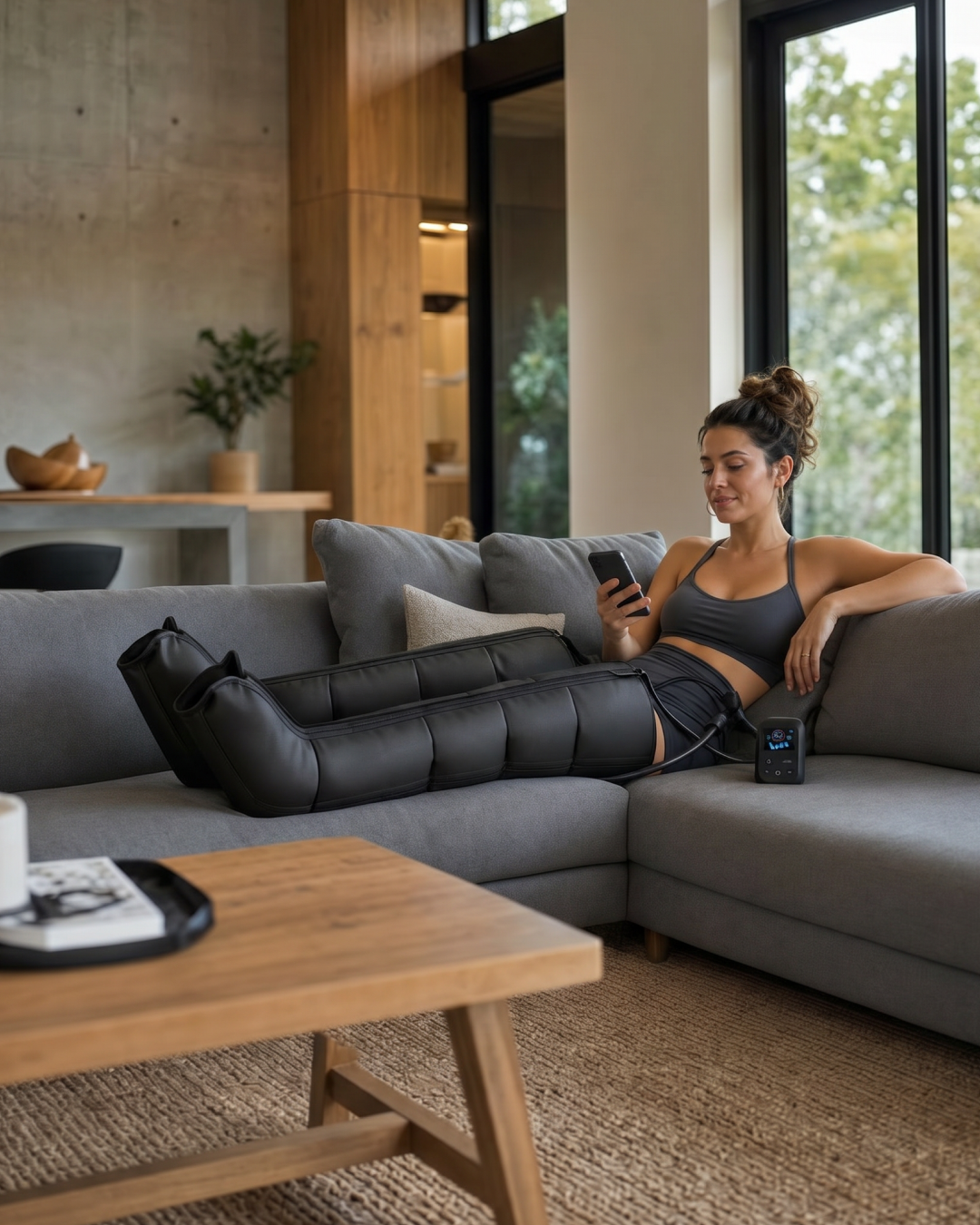
See it work
The wave moves one way: up
Four overlapping chambers inflate in sequence — foot, calf, knee, thigh — gently squeezing pooled fluid back toward your core. Then everything releases, and the wave starts again.
The cycle
- Four chambers overlap into one wave — foot to thigh
- Pooled fluid moves up, back to the core
- 15 / 30 / 45-minute timer · auto shut-off
You set the squeeze — from a gentle 30 to a deep 240 mmHg. Cordless, so it works on the couch, in bed, anywhere.
The 15-minute session
Step by step
Do it on the couch, on your bed, or at your desk — anywhere you can put your feet up for a quarter of an hour.
Charge & power on
Top up the control unit with the USB-C cable (a full charge takes about 3 hours and lasts around a week of daily sessions). Press and hold the power button until the display lights up.
Zip into the boots
Sit down, slide each leg in so your heel sits snugly in the foot pocket, and zip from ankle to upper thigh. Thin leggings or bare legs both work — the fit should be snug, never pinching.
Pick a program & pressure
Choose one of the 5 massage programs, then set your pressure anywhere from a feather-light 30 up to a deep 240 mmHg. Start low (80–120) for your first few sessions and set the timer — 15, 30 or 45 minutes.
Feet up, let the wave run
Lie back or recline with your legs supported. The chambers inflate in sequence from your feet to your upper thighs — squeeze, hold, release — pushing pooled fluid back into circulation. The unit shuts off automatically when time is up.
Unzip & air out
Unzip, step out, and stand up slowly — legs often feel noticeably lighter right away. Leave the boots unzipped for a few minutes to air, then fold them flat for storage.
Five massage programs
Pick the program for the moment
Full Wave
The classic foot-to-thigh sequence. Even, overlapping compression up the whole leg.
Deep Flush
Longer holds at each chamber for a stronger lymphatic-drainage style massage.
Pulse Wave
Quicker, rhythmic waves that feel like a brisk massage rolling up your legs.
Lower Focus
Concentrates the cycle on feet and calves, where fluid pools most.
Gentle Drift
Slow, soft cycles at low pressure — barely-there compression to wind down.
How often
Build it into your week
15–30 minutes, once a day or after every hard session. Like the pros — consistency beats marathon sessions.
- Pulse Wave or Full Wave, 15–30 min within an hour of finishing
- Moves the metabolic waste your muscles just produced
- Legs feel fresher for tomorrow's session
- Deep Flush or Lower Focus for 15 min, feet up
- Ideal after long standing, desk marathons or flights
- De-puffs ankles and calves before the evening
- Gentle Drift at low pressure ~1 hour before bed
- Pair with a book or a show — it shuts off by itself
- Heavy-leg restlessness eases into sleep-ready calm
Most people notice lighter legs after the very first session. Give it 2–3 weeks of regular use and it becomes the part of the day your legs look forward to.
Care & charging
Keep it in top shape
- Wipe the boots inside and out with a soft, slightly damp cloth — never machine-wash or submerge them.
- Let the boots air fully before folding; store flat or loosely rolled, away from direct sun.
- Recharge via USB-C when the battery indicator is low — about 3 hours to full.
- Keep zips clear of fabric and close them gently; don't force a zip over bunched clothing.
- Don't place heavy objects on the boots or fold them tightly across the air chambers.
Safety first
Important precautions
Holtrow Flow is a wellness and recovery device, not a medical treatment, and is not intended to diagnose, treat or cure any condition. Compression should always feel like a firm, pleasant squeeze — if it's ever painful, numb or tingling, lower the pressure or stop.
Do not use if you:
- Have, or suspect, deep vein thrombosis (DVT), a blood clot or thrombophlebitis
- Have severe peripheral artery disease or severe atherosclerosis
- Have decompensated heart failure or acute pulmonary edema
- Have an active skin infection, open wounds or unhealed fractures on your legs
- Are pregnant, or have severe diabetes-related neuropathy — check with your doctor first
If you have any circulatory condition, recent surgery, or any doubt at all, consult your doctor before use.
Troubleshooting
Quick fixes
The pressure feels too strong
Lower the mmHg setting straight away — the range runs from a feather-light 30 to a deep 240, and the sweet spot for most people is 80–150. Switch to Gentle Drift if you want the softest cycle.
The boots aren't inflating
Check the unit is charged and powered on, the air connections are clicked fully in, and the zips are completely closed. A boot that isn't fully zipped can't build pressure.
One chamber feels weaker than the others
Make sure that section of the boot isn't folded or twisted, and that clothing isn't bunched underneath it. Re-seat the leg so your heel is snug in the foot pocket and restart the cycle.
The boots feel too tight before they even inflate
Check your size — Flow comes in four heights (M to XXL) so the chambers align with your leg. Wearing thick trousers inside the boot can also make the base fit too tight; switch to bare legs or thin leggings.
How long until I see results?
Lighter legs are usually immediate — that's the pooled fluid moving. Consistent improvements in how your legs recover build over 2–3 weeks of regular sessions.
Can I use it every day?
Yes — 15–30 minutes daily is exactly how it's designed to be used. Athletes often run it after every training session plus an evening wind-down.